
Why These 3 Common Influencer Vetting Methods Fail

You've got a dozen collaboration requests in your inbox, or found a few travel influencers who look promising on the surface. Now comes the hard part: how do you decide who is actually worth hosting?
The right partnership can showcase your property to thousands of ideal guests. But the wrong one is more than just the cost of a comped stay or meal, it's a waste of your time, a drain on your budget, and a risk to your brand's reputation.
Worse, one bad partnership signals to others that you're an easy mark, flooding your inbox with even more low-quality requests.
To protect themselves, most hotel marketers follow the established playbook for vetting influencers. But what if that playbook is the problem? The methods we were taught to trust are often inefficient and dangerously misleading.
Let's break down three of the most common, and why they fall short.
Vetting Method #1: The "Eyeball Test"
You know the drill: you scroll through an influencer's feed, check their follower count, look at the general "vibe" of their posts, and at the likes and comments on their recent posts.
Why it seems logical: It's fast, free, and intuitive. A large follower count and high engagement levels seem like a great opportunity for collaboration.
Why it fails: The eyeball test only shows you the surface, and the surface metrics can be easily faked.
- Vanity metrics lie. Follower counts, likes, and comments can all be bought easily. Worse, this method tells you nothing about who the followers are. 100,000 followers in Brazil are useless if your key demographic is millennials from California.
Don't believe how easy it is? Here’s a look at just a few of the services available online:

Services that sell fake followers, likes, and comments are cheap and widely available, making it easy to create the illusion of a popular account. When you host an influencer based on these fake numbers, you aren't investing in marketing. You're just funding a stranger's vacation.
Vetting Method #2: Relying Only on Media Kits
This feels like a step up. You ask the influencer to send over their media kit, which includes self-reported stats, audience demographics, and examples of past brand collaborations.
Why it seems logical: A professional media kit looks official, organized, and data-driven.
Why it fails: A media kit isn't a report, it's a resume. It's a sales document designed to do one thing: sell you on a partnership.
- The data is biased. Influencers will only include their most flattering or visible numbers. You're seeing a highlight reel, not the full picture needed to make a sound hosting decision.
- The data is often irrelevant. Most media kits show a 90-day or monthly overview of their account stats. This doesn't tell you how individual posts perform, which is what actually matters for your campaign.
- The manual work is impractical. Even if the numbers were 100% accurate, it's not feasible for you to verify them. Are you really going to spend hours manually calculating the true engagement rate across dozens of past posts? Of course not, your time is too valuable.
- The screenshots are strategically cropped. Have you ever noticed how the screenshots they provide are perfectly cut off? This is often intentional. You're seeing the story they want you to see, not the reality you need to make a smart decision.
The difference between a media kit and reality can be dramatic. Here’s a real-world example comparing what an influencer put in their media kit versus the actual first-party data pulled through the Evolusen.
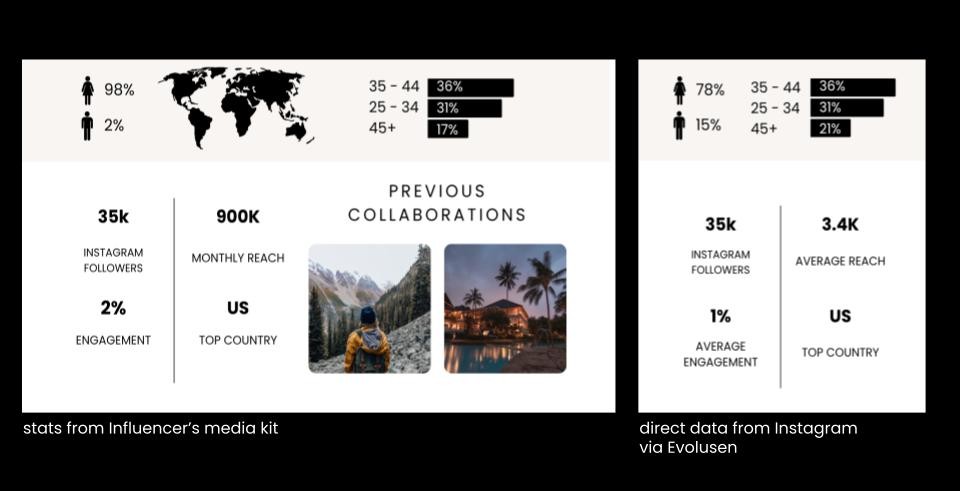
Notice the differences? The influencer's real engagement is half of what was claimed. More importantly, the media kit highlights a vanity metric like "Monthly Reach," while the direct data shows the more realistic and valuable "Average Reach per Post.
Tired of biased media kits and fake followers? There's a better way to vet influencers with confidence. Learn more about the tool built to replace guesswork with certainty.
Vetting Method #3: Trusting Free Online "Auditors"
Frustrated with manual checks, many marketers turn to free websites that promise to "audit" an Instagram account. You plug in their handle and get a quick "health score" or "authenticity rating."
Why it seems logical: It feels more tech-savvy than just eyeballing or relying on media kits, and it's free. It provides a simple score that seems to answer the question, "Is this account real?"
Why it fails: You get what you pay for. These free tools provide surface-level data and guestimates that don't actually tell the real story.
- They are fundamentally blocked from real data. There's a simple technical reason these tools are flawed: the only way to access an influencer's accurate audience data (like demographics and location) is with their direct permission via the official Instagram API. Since free tools don't ask for this permission, you can "access" their insights instantly, they are limited to "scraping" public information like follower counts and comments, the same things you can see with your own eyes.
- They rely on wildly inaccurate "guesstimates." So how do they report on audience demographics without real access? They guess. They use sampling data and predictive modeling to create a guesstimate of an account's followers. The problem is, these estimates are often completely off from the influencer's actual, first-party data.
Look at this comparison between a popular free audit tool and the direct data pulled by Evolusen for the exact same account:
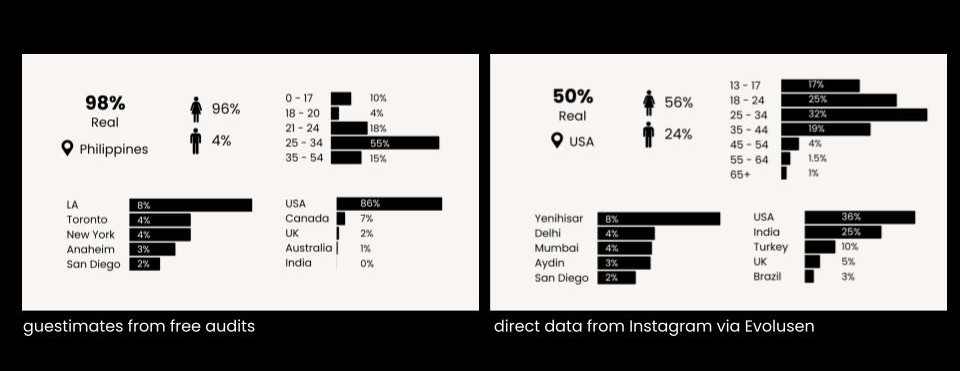
The free tool's guesstimate: A North American audience, mostly aged 25-34. The reality from direct data: A completely different audience across the USA, India, and Turkey, with 43% being 24 or younger. This is the kind of critical mistake that can ruin a campaign.
- They create a false sense of security. This is the biggest danger. You think you're making a data-driven choice, but the data itself is fundamentally flawed. Making a decision based on incorrect data is often worse than relying on your gut alone, because it gives you a false confidence that you're making a smart move.
A Better Way: From Guesswork to Certainty
Let's be honest: a few years ago, you could probably get by with the eyeball test or a simple media kit. For most hotels, Influencer marketing was an experiment.
That's not the reality anymore. With real budgets on the line, relying on an outdated playbook isn't just inefficien, it's a direct risk to your bottom line.
The trend is clear: savvy hotels are now making hotel influencer marketing a core part of their strategy.
But this shift also creates a huge opportunity. Think about your compset. They are more than likely stuck in the old ways, basing their hosting decisions on vanity metrics. While they are funding strangers' vacations, you can partner exclusively with authentic creators who drive real results. It's the fastest way to get more with less and make your marketing budget work smarter.
This exact frustration and this opportunity to help our partners to get ahead is why we built the audit tools inside the Evolusen. We knew hospitality pros needed a single source of truth, a way to replace outdated methods with undeniable, first-party data.
Instead of relying on flawed methods, our system gives you everything you need to vet with confidence:
- It goes beyond follower counts to show you verified audience demographics.
- It replaces the biased media kit with real, unbiased data directly from the source.
- It gives you a comprehensive authenticity report based on their account behavior over time.
It turns a high-risk, hours-long process into a simple, confident decision.
Make Your Next Hosting Decision a Confident One
Your time is too valuable to waste on vetting methods that don't work. Stop relying on vanity metrics and self-reported data, and start with proof: verified, first-party data on every influencer before you approve them.
See how hotel influencer marketing works when every hosting decision is backed by real numbers.
What Does a Hotel Influencer Program Actually Cost?

How to Choose an Influencer Marketing Solution for Your Hotel